

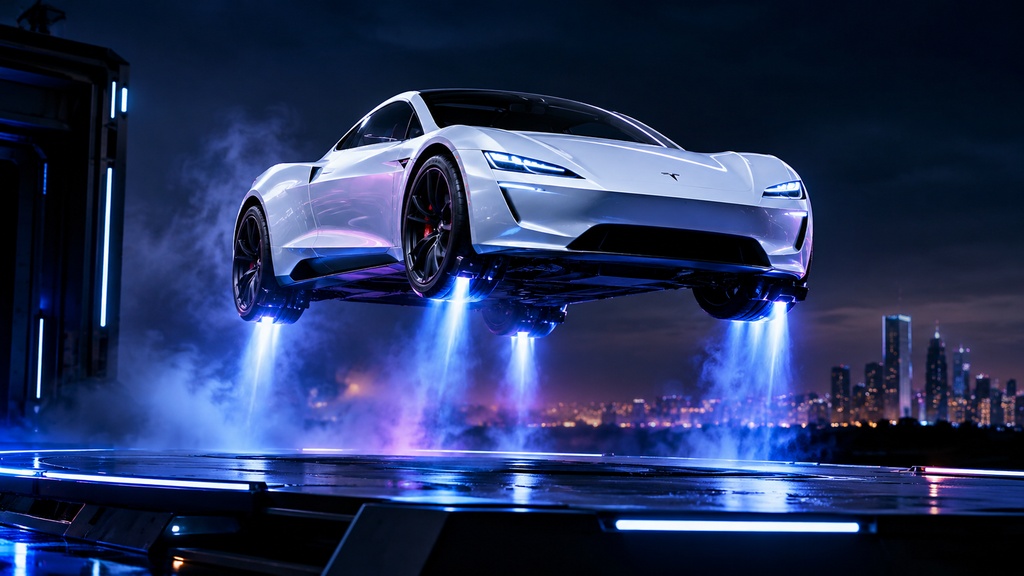
Tesla Flying Roadster 2026: Is Elon Musk Bringing Flying Cars to the Real World?
Introduction
The future of automobiles is becoming more exciting as technology companies explore new ways to make transportation faster, smarter, and more efficient. Elon Musk, the CEO of Tesla and SpaceX, has introduced a new version of the long-awaited Tesla Roadster that features rocket-style thrusters capable of lifting the vehicle into the air for brief maneuvers. The demonstration took place in Texas in October 2026 and attracted significant attention from technology enthusiasts, electric vehicle fans, and automotive experts. <Cite refs={[“turn442194news25″,”turn442194search10”]}/>
The vehicle combines electric-car engineering with technology inspired by aerospace systems. During its demonstration, the Roadster performed unusual maneuvers, including lifting off the ground, rotating in the air, and landing back on its wheels.
However, there is an important distinction between a car that can briefly lift off the ground and a fully functional flying car capable of carrying passengers through the sky. Tesla’s demonstration represents an experimental approach to vehicle performance rather than a replacement for conventional aircraft.
In this article, we explore the new Tesla Roadster, its potential features, flying technology, performance claims, expected release date, possible price, safety concerns, and what this development could mean for the future of transportation.
What Is Elon Musk’s New Flying Tesla Roadster?
The Tesla Roadster is an electric sports car designed to deliver exceptional acceleration, high performance, and a futuristic driving experience. Tesla originally revealed its next-generation Roadster in 2017, but the vehicle experienced repeated delays before its latest demonstration in October 2026.
The newly demonstrated version attracted attention because of its rocket-style propulsion system, developed in collaboration with SpaceX. Unlike a traditional flying car that uses wings, propellers, or multiple electric rotors, this Roadster uses high-pressure gas thrusters to perform brief airborne maneuvers.
During the demonstration, the vehicle used specialized systems to move along an unusual ramp, rotate in midair, and return to the ground. A separate demonstration showed it jumping over other vehicles.
These capabilities make the Roadster different from most electric sports cars currently on the market. Nevertheless, the demonstration does not mean the car can fly long distances, travel between cities through the air, or operate like a private aircraft.
Tesla plans to begin production in 2028, according to reports following the unveiling. That means interested buyers will need to wait for further information about the production model, specifications, and availability. <Cite refs={[“turn442194news25″,”turn442194search6”]}/>
How Does the Flying Technology Work?
One of the most interesting aspects of the new Roadster is its use of technology inspired by rocket engineering.
SpaceX develops launch vehicles and spacecraft, while Tesla focuses on electric vehicles, battery systems, and automotive engineering. Combining ideas from these fields allows engineers to explore unusual vehicle capabilities.
The Roadster’s experimental system uses high-pressure gas stored in specialized tanks. When the gas is released through directional nozzles, it creates thrust that can move the vehicle in a particular direction.
The principle is related to rocket propulsion: pushing gas in one direction produces a force in the opposite direction. By controlling the direction and timing of the thrust, an engineered system can produce brief movements that would be impossible for an ordinary car.
The demonstration also involved a suction-based system that helped the vehicle travel along an inverted ramp. This is a separate mechanism from the thrusters themselves.
It is important to understand that these systems are not equivalent to the propulsion technology used by conventional aircraft. They are designed for specialized maneuvers and would require substantial engineering, control systems, and safety measures before any broader application could be considered.
For everyday transportation, engineers would also need to address energy consumption, passenger comfort, mechanical reliability, and safe operation around people and buildings.
Key Features of the New Tesla Roadster
The new Roadster is intended to showcase Tesla’s performance ambitions and its experimental work with aerospace technology. Several features have attracted attention.
1. Rocket-Style Thrusters
The most unusual feature is the experimental thruster system developed with SpaceX technology. It allows the demonstrated vehicle to perform short airborne movements and aerial rotations.
Unlike the electric motors that normally drive the wheels, the thrusters provide additional force through expelled gas. This creates new possibilities for vehicle demonstrations, but it also introduces challenges involving pressure storage, control, and safe operation.
The technology should not be confused with a conventional flying-car system capable of sustained flight.
2. Fully Electric Powertrain
The Roadster is designed as an electric sports car. Its main driving system uses electric propulsion rather than a traditional petrol engine.
Electric vehicles offer several advantages, including immediate motor response, quiet operation, and the ability to recharge their batteries instead of refuelling with gasoline.
Tesla’s experience with battery technology and electric drivetrains provides the foundation for the Roadster’s road-going performance. However, the additional equipment used in the experimental Rocket configuration may affect its weight, passenger space, and driving range.
3. Extreme Acceleration
Tesla has promoted extremely ambitious performance figures for the new Roadster. At the unveiling, the company presented an acceleration target of 0 to 60 miles per hour in under one second for the advanced version.
That figure is exceptionally aggressive and should be treated as a manufacturer claim rather than an independently verified everyday performance result.
Actual acceleration depends on road conditions, tyres, traction, vehicle configuration, battery performance, and testing methods.
If the production car approaches its advertised targets, it could become an important competitor in the electric performance-car market.
4. Futuristic Exterior Design
The Roadster follows the styling of a high-performance electric sports car, with a low profile, aerodynamic bodywork, and a design intended to reduce air resistance at high speeds.
Aerodynamics matter because air resistance increases as a vehicle travels faster. A carefully designed exterior can improve stability and help a car use its available energy more efficiently.
The vehicle’s futuristic appearance also supports Tesla’s aim of creating a flagship car that demonstrates the company’s engineering ambitions.
5. Advanced Engineering
The collaboration between Tesla and SpaceX brings together two different engineering disciplines.
Automotive engineering focuses on road safety, vehicle control, durability, and passenger comfort. Aerospace engineering deals with propulsion, pressure systems, flight dynamics, and operation under demanding conditions.
Bringing these fields together can encourage new ideas, although a technology that works during a controlled demonstration may still require extensive testing before it becomes suitable for customers.
Is It Really a Flying Car?
This is the most important question surrounding the new Tesla Roadster.
In everyday conversation, a flying car usually means a vehicle that can travel on roads and also fly through the air. Some designs use folding wings, while others rely on vertical-lift rotors or electric propulsion systems.
Tesla’s demonstrated Roadster is different. Its rocket-style thrusters can produce brief airborne maneuvers, but that does not establish that the vehicle can sustain controlled flight over long distances.
A short jump is not the same as travelling several kilometres through the air. Sustained flight requires a reliable method of generating lift, controlling direction and altitude, managing energy, and landing safely under a wide range of conditions.
The distinction also matters for passengers. A vehicle designed for a dramatic demonstration may not be suitable for normal use in residential areas, on public roads, or near other aircraft.
Therefore, the Roadster is best described as an experimental electric sports car with rocket-assisted airborne capabilities, rather than a practical flying taxi or a replacement for helicopters.
Tesla Roadster Performance and Expected Specifications
The following table summarises the main information reported about the new Roadster and identifies what remains uncertain.
| Feature | Reported details |
|---|---|
| Vehicle type | Electric performance sports car |
| Experimental technology | SpaceX-inspired rocket-style thrusters |
| Demonstrated capability | Brief airborne maneuvers |
| Acceleration target | 0–60 mph in under one second for the advanced version |
| Production target | 2028 |
| Passenger configuration | Two-seat design reported |
| Final production specifications | Subject to confirmation |
| Sustained flight capability | Not established by the demonstration |
| Public-road approval for Rocket version | Not established; restrictions apply |
These details are based on reporting from the unveiling and should not be interpreted as a complete, independently verified specification sheet. <Cite refs={[“turn442194news25″,”turn442194search5″,”turn442194search15”]}/>
What Could Be the Price of Tesla’s Flying Roadster?
Price is another major question for potential buyers. The Roadster is expected to sit in the high-performance luxury-car category, making it more expensive than ordinary electric vehicles.
Reports following the unveiling described different reservation deposits for the planned versions, including a substantially more expensive Rocket configuration. However, a reservation deposit is not the same as the final purchase price, and the complete production pricing has not been clearly established.
The Rocket version may also be produced in limited quantities or offered under special conditions. If that happens, it could appeal primarily to collectors, technology enthusiasts, and wealthy customers interested in unusual vehicles.
Potential buyers should wait for official pricing, final specifications, delivery conditions, and refund policies before committing money.
Customers should also remember that owning a high-performance electric vehicle can involve additional expenses, including insurance, maintenance, tyres, charging equipment, and specialist repairs.
For the most reliable information, buyers should consult Tesla’s official Roadster page and any published purchase terms rather than relying on social media rumours.
When Will the New Tesla Roadster Be Released?
Following the October 2026 demonstration, Tesla’s stated production target is 2028. However, the vehicle’s development history shows why it is important to distinguish a target date from a confirmed delivery schedule.
The next-generation Roadster was first announced in 2017, with deliveries initially expected much earlier. Its development has subsequently faced multiple delays.
Before production begins, Tesla must finalise the vehicle’s design, engineering, manufacturing arrangements, and customer-delivery plans. The experimental thruster configuration also raises additional questions about testing and regulatory requirements.
The Rocket version and any conventional road-going version may have different capabilities and restrictions. Consequently, customers should not assume that every feature shown during the demonstration will be included in every production model.
Until Tesla provides a confirmed delivery schedule and final production details, 2028 should be understood as the current target rather than a guaranteed release date. <Cite refs={[“turn442194search0″,”turn442194news25″,”turn442194search5”]}/>
Safety Challenges and Legal Questions
Although the Roadster’s demonstration was visually impressive, safety will be one of the biggest challenges if rocket-assisted vehicles are ever intended for wider use.
A conventional car is designed to remain in contact with the road. Its tyres, brakes, suspension, steering, and electronic stability systems are built around that requirement.
Once a vehicle leaves the ground, even briefly, different risks emerge. Engineers must consider how the vehicle responds to wind, how its position is controlled, how it lands, and what happens if a propulsion component fails.
High-pressure gas systems also require careful management. Tanks, valves, pipes, and nozzles must withstand demanding operating conditions without exposing passengers or bystanders to unacceptable risks.
There are legal questions as well. A vehicle that can leave the ground may fall under rules different from those that apply to ordinary road cars. Authorities would need to determine how such vehicles could be tested, registered, operated, and insured.
A demonstration at a controlled facility does not automatically establish permission to use the same technology on public roads.
For these reasons, safety testing and regulatory approval will be essential before the technology can become a routine part of transportation.
Advantages of Combining Electric Cars With Aerospace Technology
Despite these challenges, the Roadster highlights several interesting possibilities.
First, collaboration between automotive and aerospace engineers can lead to new approaches to propulsion, materials, and vehicle control. Research conducted for specialised applications may eventually contribute to other engineering projects.
Second, electric drivetrains provide a platform for precise motor control and efficient energy use. These characteristics are valuable in cars and can also be important in some electric aircraft.
Third, high-profile demonstrations can increase public interest in science, engineering, and advanced manufacturing. They encourage people to ask how propulsion systems work and what technologies might become possible in the future.
Finally, flagship vehicles can help companies demonstrate their technical ambitions. Even if a specialised model is produced in limited quantities, some ideas developed during its creation may influence future products.
However, these potential benefits should not be confused with proof that rocket-assisted cars will become affordable or practical for everyday commuters.
Could Flying Cars Change the Future of Transportation?
The idea of flying cars has attracted inventors and engineers for decades. Modern electric motors, lightweight materials, computer-controlled flight systems, and improvements in battery technology have encouraged renewed interest in this field.
Several companies are exploring electric vertical take-off and landing aircraft, commonly called eVTOLs. These vehicles typically use multiple rotors or other lifting systems to take off and land without a conventional runway.
Such aircraft could eventually support specialised transportation services, including airport transfers, emergency operations, and selected urban routes. However, they face significant challenges involving infrastructure, noise, weather, operating costs, air traffic management, and certification.
Tesla’s Roadster follows a different approach. Instead of being designed primarily as an aircraft, it begins with the concept of a high-performance road car and adds experimental airborne capabilities.
That makes it an interesting engineering project, but it does not solve all the problems associated with flying transportation.
For most people, the future of mobility is more likely to involve a combination of electric cars, improved public transport, autonomous driving systems, and specialised aircraft than a single vehicle that can do everything.
How Does the Roadster Compare With Ordinary Electric Cars?
Ordinary electric vehicles are built to provide reliable transportation. Their priorities include battery range, charging speed, passenger comfort, affordability, and safety.
The Roadster has a different purpose. It is a high-performance flagship vehicle intended to showcase advanced engineering and attract attention to Tesla’s technology.
A typical electric family car may be far more practical for commuting, shopping, and long journeys because it does not need specialised thrusters or experimental propulsion equipment.
The Roadster’s technology may appeal to enthusiasts who value extreme performance and unusual engineering. Nevertheless, buyers should evaluate its actual production specifications rather than choosing it solely because of a dramatic demonstration.
For everyday drivers, factors such as reliable charging access, total ownership cost, repair support, and safety ratings will remain more important than the ability to perform an airborne stunt.
Final Thoughts
Elon Musk’s newly demonstrated Tesla Roadster has brought fresh attention to the idea of flying cars. By combining an electric sports-car platform with SpaceX-inspired rocket thrusters, Tesla has demonstrated an unusual approach to vehicle performance.
The Roadster’s brief airborne maneuvers, futuristic design, and ambitious acceleration targets make it an interesting development in automotive engineering. At the same time, major questions remain about final pricing, production specifications, safety, regulatory approval, and the availability of the most experimental version.
Tesla currently targets 2028 for production, but customers should treat that date as a plan rather than a guarantee. The vehicle should also not be confused with a conventional aircraft capable of sustained flight.
Ultimately, the Roadster demonstrates how far companies are willing to push the boundaries of electric vehicles. Whether its rocket-assisted technology becomes more widely useful will depend on future testing, engineering improvements, and regulatory decisions.
For readers interested in electric vehicles, artificial intelligence, aerospace innovation, and future transportation, this project is worth following as more verified details emerge.
Stay connected with Tech Nova USA for the latest technology news, electric vehicle updates, AI developments, and futuristic innovations.
Hashtags
#Tesla #ElonMusk #FlyingCar #TeslaRoadster #SpaceX #ElectricVehicles #FutureTechnology #TechNews #Innovation #TechNovaUSA
Keywords
Tesla Flying Roadster, Elon Musk flying car, Tesla Roadster 2026, Tesla Roadster 2028, SpaceX thrusters, electric flying car, new Tesla car, futuristic electric vehicles, Tesla Roadster features, future transportation.